
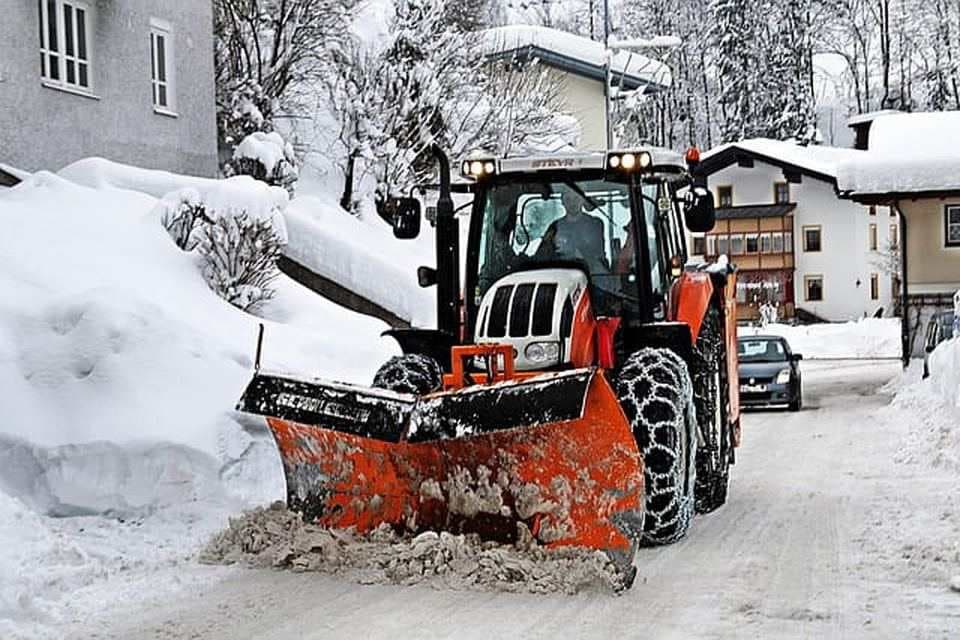
Owners of properties in a built-up area (Ortsgebiet) must clear snow from the pavements and footpaths along their property and grit them in snow and ice. This applies to paths no more than 3 metres from the property, every day from 6 am to 10 pm. The legal basis is § 93 of the Austrian Road Traffic Regulations 1960 (StVO). The duty can be transferred to a winter service company by contract.
Who is obliged to clear snow under § 93 StVO?
The duty lies with the owners of properties in a built-up area. The only exception is undeveloped land used for agriculture or forestry. A built-up area is the stretch between the town entry sign (Ortstafel) and the town exit sign (Ortsende). The same duty applies to owners of sales kiosks.
Tenants are not automatically obliged under § 93 StVO. The duty stays with the owner unless it has been expressly transferred by contract.
In owner-occupied apartment buildings, the property management usually organises winter service on behalf of the owners. It hires a caretaker or a winter service company and checks the work.
Which areas must be cleared and gritted?
Owners must clear the public pavements and footpaths along the entire property if they are no more than 3 metres away from it. This includes steps along these paths. Where there is no pavement, a 1-metre strip at the edge of the road must be cleared and gritted.
In practice this means:
- Pavement directly by the building or behind a narrow verge of up to 3 metres: clear and grit
- No pavement: the edge of the road, 1 metre wide
- Pedestrian zone or residential street without pavements: a 1-metre strip along the building fronts
- Carriageway: cleared by the road authority, not by the property owner
Private driveways, car parks and entrances on private land are not covered by § 93 StVO. Other grounds for liability may apply to them, such as the liability of path keepers under § 1319a of the Austrian Civil Code (ABGB) or obligations under a tenancy agreement. If tenants, customers or suppliers walk there, these areas should be cleared and gritted too.
At what times does the duty apply?
The duty applies every day from 6 am to 10 pm, including weekends and public holidays. The law does not set a fixed number of rounds. During this period the areas must be cleared of snow and gritted in snow and ice. During continuous snowfall, clearing once in the morning is therefore usually not enough.
If you want a safe pavement at 6 am, you have to start earlier. That is why winter services often go out during the night when it snows. Re-gritting in the afternoon and evening is just as important, when meltwater freezes again.
What about snow and ice on the roof?
Under § 93 (2) StVO, owners must also make sure that snow cornices and ice are removed from the roofs of their buildings facing the street. This must not endanger or obstruct passers-by. Where necessary, the danger zone must be cordoned off or marked.
Icicles on gutters and snow overhangs above pavements and entrances are the main hazard. Because of the fall risk, roof work belongs in the hands of professionals with proper fall protection.
Can the duty be transferred?
Yes. Under § 93 (5) StVO the duties can be transferred by a legal transaction, i.e. a contract. Whoever takes them on steps into the owner's place. The duties under § 93 StVO and the responsibility for them pass to the contractor.
For the transfer to hold up if something happens, the contract should be in writing and cover at least these points:
- the exact areas, ideally with a site plan: pavement, steps, entrances, car parks
- the season and service hours, at least 6 am to 10 pm
- the gritting material and who removes the grit in spring
- documentation of every call-out with date, time and action taken
- whether icicles and snow overhangs on the roof are included
- a contact person who can be reached when it snows
Verbal agreements with tenants or neighbours are hard to prove in a dispute. A written contract with clearly described areas gives both sides certainty.
We provide winter service in Graz for residential buildings, property managers and commercial properties and document every call-out.
What happens if snow is not cleared or gritted?
Breaching the duty is an administrative offence under the StVO and can lead to a fine. The civil side is usually more serious: if someone falls on an uncleared pavement, the person responsible can be held liable for damages, such as compensation for pain and suffering and treatment costs.
That is why documentation matters so much. A log with time, weather conditions and action taken shows in a dispute that the area was cleared and gritted. Time-stamped photos help as well.
What should owners and property managers do before winter?
Before the first snow, settle who clears, which areas are included and how call-outs are documented. A winter service contract should be in place by autumn at the latest. If you clear snow yourself, you need equipment, grit and cover for weekends and holidays.
This checklist has proven useful:
- Record the areas under § 93 StVO: length of pavement along the property, steps, paths without a pavement
- Add private entrances, driveways and car parks used by tenants and visitors
- Sign or renew a winter service contract with a site plan and service hours
- If you do it yourself: provide shovels, snow pushers and enough grit, and arrange cover
- Have gutters and roof areas above pavements checked for icicle and snow overhang hazards
- Put up a notice telling tenants who is responsible and how to reach them
Grit or salt: what makes sense?
Grit makes slippery surfaces safer immediately and also works in hard frost. Road salt melts ice but loses effect at very low temperatures. Salt also damages plants, concrete and natural stone steps. For pavements and steps, grit is therefore usually the better choice.
Check whether your municipality or your contract specifies gritting materials. Grit has to be removed again in spring, including from the stairwell. A good moment for a deep clean of the entrance area. More on this in our article Deep cleaning or routine cleaning?
Sources
Questions about your property?
We inspect your property in Graz and the surrounding area free of charge and then give you a fixed price.
Send an enquiry